 Open App →
Open App →
Open App →
MatchPredix uses a bivariate Poisson model trained on thousands of matches to find where the bookmakers have priced things wrong — then shows you exactly where the value is.
Try It FreeWe feed historical match data — goals, corners, cards, shots, referee records — into a statistical model that calculates the true probability of every outcome. Then we compare those probabilities against real bookmaker odds from the likes of bet365, Betfair, William Hill and more.
When the bookmaker's odds suggest something is less likely than our model says it is, that's called edge — and that's where you make money over time. The bigger the edge, the more the bookmaker has underpriced the bet.
10+ seasons of match results, team form, referee tendencies, home/away splits — updated every week via automated data feeds.
A bivariate Poisson distribution calculates expected goals for each team, then derives probabilities for every market — goals, BTTS, corners, cards, result.
We compare model probabilities against live bookmaker odds in real time. Green edge = value. The picks with the highest edge go into our recommended accumulators.
Choose from Premier League, Championship, or EFL League One to view that division's match cards and predictions. Each league has its own model trained on that division's data. The recommended accumulator tabs automatically pool the best picks from all three leagues — you don't need to switch between them.
Fixtures load automatically when you open the page, showing every upcoming match for the selected league. Hitting Update & Predict runs the full model server-side and pulls live odds from 15+ bookmakers. The whole process takes a few seconds.
Each match shows predicted goals, probabilities for Over/Under lines, BTTS, corners, cards, and the match result. Green percentages mean positive edge against the best available odds. Tap any odds badge to add it to your accumulator.
Every slider defaults to the model's predicted line for that match — so if we expect 3.7 goals, you'll see Over 3.5 rather than a generic Over 2.5. BTTS defaults to whichever side the model favours (Yes or No). You can still drag any slider to explore other lines.
Don't want to pick manually? Our recommended accumulator tabs do the work for you — each one is backtested against real historical data. Pick the strategy that suits your style and stake.
After matches finish, the Results tab shows how the model's predictions performed. Each match is scored against the line the model recommended — not a fixed Over 2.5 for every game. If the model predicted Over 3.5 goals, it's marked as a hit or miss against that line. BTTS results are scored against whichever side (Yes or No) the model favoured. This gives you an honest picture of model accuracy based on what it actually predicted.
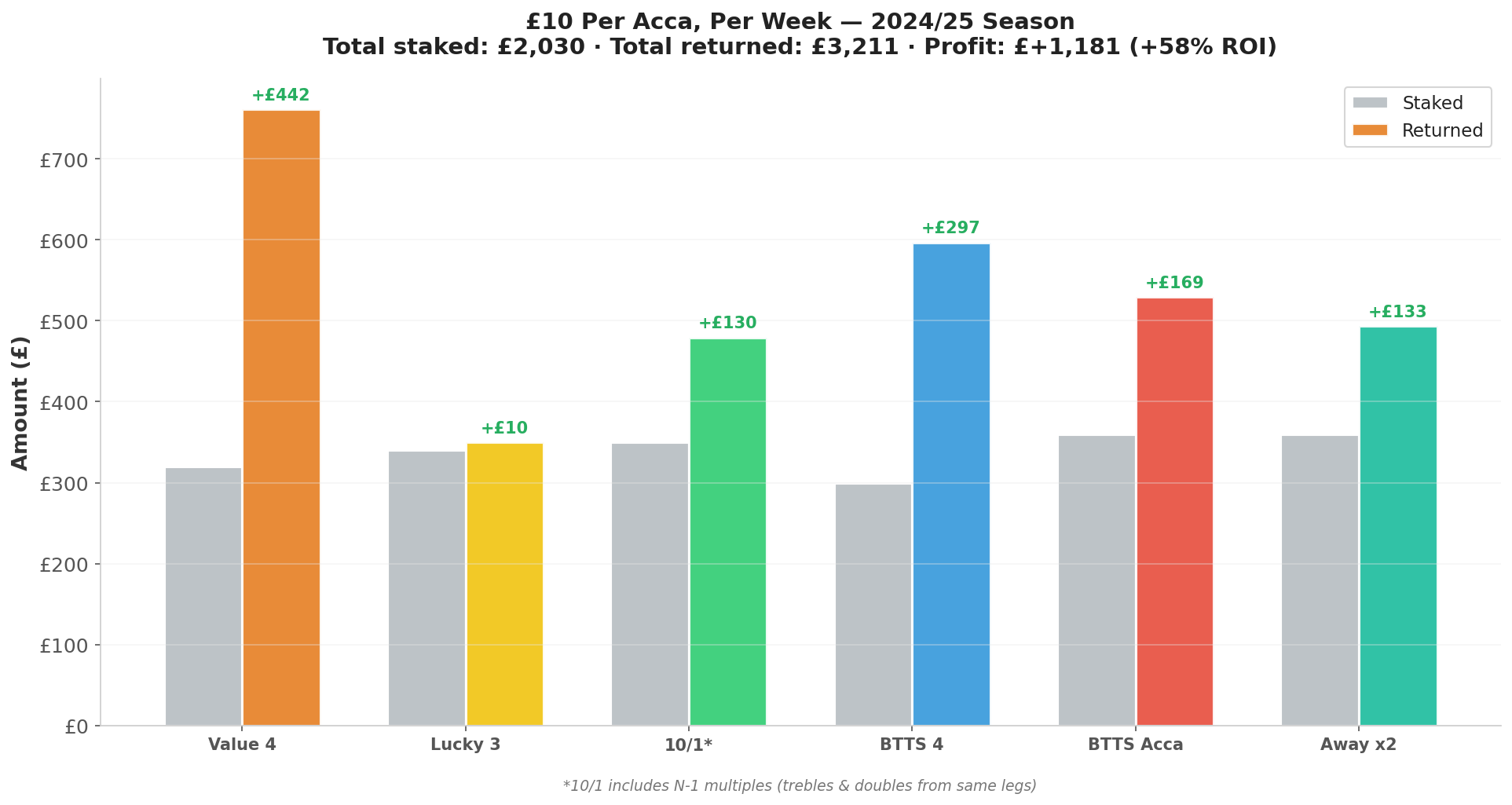
Every recommended acca is generated by the model, not hand-picked. Each strategy has been backtested over a full season of data to verify it produces a positive return. All tabs pool picks from across Premier League, Championship, and EFL League One to find the best value wherever it exists. Here's what each one does:
⚠ Important caveat: ROI figures shown are single-season backtests using best-of-market odds. Multi-season performance shows wider variance — some accas that look strong in one season are flat or negative across 12. Some BTTS-related ROIs use simulated bookmaker odds where real historical odds were unavailable. Past performance does not predict future results. Predictions are for entertainment only, never bet money you can't afford to lose. Full disclaimer →
Verified figures and live performance charts will populate here from the 2026/27 season — first meaningful sample lands after roughly 8 weeks of fixtures. The 2024/25 single-season backtest numbers previously shown here over-stated several strategies when re-checked against 12 seasons of historical data, so they've been pulled until real-data verification is in. Methodology unchanged; only the figures are deferred.
The overview above covers everything you need to use MatchPredix. But if you're the kind of person who wants to understand the maths behind the predictions, read on.
At the core of MatchPredix is a bivariate Poisson distribution — a statistical model that treats the number of goals scored by each team as two related Poisson random variables. Unlike simpler models that predict goals independently, the bivariate version accounts for the correlation between home and away goal-scoring in a match.
For each team, we calculate an attack rating and a defence rating based on their historical results. The home team's expected goals (xG) is derived from their home attack strength multiplied by the away team's away defence weakness, relative to the league average. The same calculation runs in reverse for the away team.
These ratings are built from 10+ seasons of data from football-data.co.uk, weighted towards recent form. Each team has separate home and away profiles because teams genuinely perform differently at home versus away — and our model captures this.
Once we have expected goals for each team, the Poisson distribution tells us the probability of every possible scoreline: 0-0, 1-0, 0-1, 1-1, 2-0, and so on up to 8-8. We sum these probabilities to derive the odds for every market:
For Over/Under goals, we sum all scoreline probabilities where the total exceeds the line. For BTTS, we sum all scorelines where both teams score at least once. For match result, we sum scorelines where the home team wins, draws, or loses.
The same Poisson approach extends to corners, cards, and shots. Each team has separate historical profiles for these statistics, and the model generates expected values and probabilities in the same way. Corner and card predictions use referee-specific data too — some referees consistently produce more cards or award more corners than others.
We maintain profiles for every referee in each division, tracking their average cards, fouls, and corners per game. When a referee is assigned to a match, their tendencies are factored into the prediction. A referee who averages 5 yellow cards per game will push the cards prediction higher than one who averages 3.
This is where it gets interesting. Once we have a model probability for an outcome, we convert bookmaker odds to an implied probability and calculate the gap:
A positive edge means the bookmaker is offering better odds than our model says they should. Over hundreds of bets, consistently taking positive-edge bets produces a profit — this is the same mathematical principle that makes the bookmakers themselves profitable, just applied in reverse.
Anyone can build a model. The question is whether it has any historical edge. We backtest every accumulator strategy against real historical data — real odds, real results, real payouts. The ROI figures on each tab are single-season backtests, not theoretical projections. Strategies that don't show positive ROI in single-season backtests don't make it onto the main page.
Caveat we own up to: when we extend the same strategies to 12 seasons, some of the single-season-positive accas turn out to be net flat or negative. ROI figures shown are best-case historical, not guaranteed long-run returns. Some BTTS results use simulated odds where real historical odds were unavailable. Always treat predictions as entertainment, not financial advice.
Historical match data — sourced from football-data.co.uk, covering 10+ seasons of English football across all three divisions. Updated weekly every Monday via automated cron job.
Fixtures — pulled from football-data.org API including confirmed referee assignments.
Live bookmaker odds — fetched in real time from The Odds API, covering 15+ major bookmakers including bet365, Betfair, William Hill, Paddy Power, Ladbrokes, Sky Bet, and more. Odds for goals, BTTS, match result, and selected specials.
Betfair Exchange odds — fetched separately for corners and cards markets where traditional bookmaker coverage is thinner. Exchange odds often represent the sharpest prices available.
Player & injury data — sourced from API-Football for squad availability and key player performance metrics that feed into the model.
All data processing runs on Cloudflare Workers with KV storage, meaning predictions are generated server-side and served instantly. The model recalculates on every "Update & Predict" press using the latest available data.